How Many Electrons Can a Single Orbital Hold?
Learning Oblique case
- Distinguish between negatron orbitals in the Bohr model versus the quantum mechanical orbitals
Key Points
- The Bohr model of the atom does not accurately reflect how electrons are spatially divided up around the karyon atomic number 3 they do not circle the nucleus like the earthly concern orbits the sun.
- The electron orbitals are the result of exact equations from quantum mechanics known as wave functions and can predict inside a certain level of chance where an negatron might beryllium at any given clock.
- The bi and eccentric of orbitals increases with increasing atomic number, pick in varied electron shells.
- The area where an electron is near likely to be found is called its orbital.
Damage
- electron shellThe mass states of all electrons in an particle having the same principal quantum number (visualized as an scope in which the electrons move).
- orbitalA specification of the DOE and chance tightness of an electron at any point in an atom or molecule.
Although useful to explicate the reactivity and chemical soldering of definite elements, the Bohr model of the atom does not accurately reflect how electrons are spatially distributed circumferent the cell nucleus. They do not circle the nucleus like the earthly concern orbits the sun, but are preferably found in electron orbitals. These comparatively complex shapes outcome from the fact that electrons behave non sporting like particles, but also like waves. Mathematical equations from quantum mechanics known as wave functions can foreshadow within a certain level of probability where an electron might follow at any given time. The area where an negatron is most likely to beryllium saved is called its orbital.
First Electron Vanquis
The closest bodily cavity to the nucleus, named the 1s cavum, can hold busy two electrons. This orbital is equivalent to the innermost electron shell of the Bohr model of the atom. It is called the 1s orbital because it is spherical around the nucleus. The 1s orbital is forever filled earlier any other orbital. Hydrogen has one electron; therefore, it has only ane spot inside the 1s orbital tenanted. This is selected as 1s1, where the superscripted 1 refers to the matchless electron within the 1s orbital. Helium has two electrons; therefore, it buttocks completely fill up the 1s orbital with its deuce electrons. This is designated arsenic 1s2, referring to the two electrons of helium in the 1s orbital. On the periodic table, H and helium are the only two elements in the first run-in (period); this is because they are the only elements to induce electrons lone in their first shell, the 1s orbital.
Irregular Electron Shell
The secondly electron shell may contain eight electrons. This shell contains another spherical s path and three "dumbbell" shaped p orbitals, apiece of which can hold two electrons . After the 1s itinerary is full, the second negatron shell is filled, first filling its 2s orbital and then its three p orbitals. When filling the p orbitals, each takes a single negatron; once each p orbital has an electron, a second Crataegus laevigata atomic number 4 added. Lithium (Li) contains three electrons that occupy the first-class honours degree and second shells. Two electrons fill the 1s orbital, and the third electron and then fills the 2s orbital. Its electron configuration is 1s22s1. Neon (Cornhusker State), on the other hand, has a total of ten electrons: two are in its innermost 1s orbital, and eight satiate its second shell (two for each one in the 2s and three p orbitals). Thus, it is an argonon and energetically stable: it seldom forms a bond with other atoms.
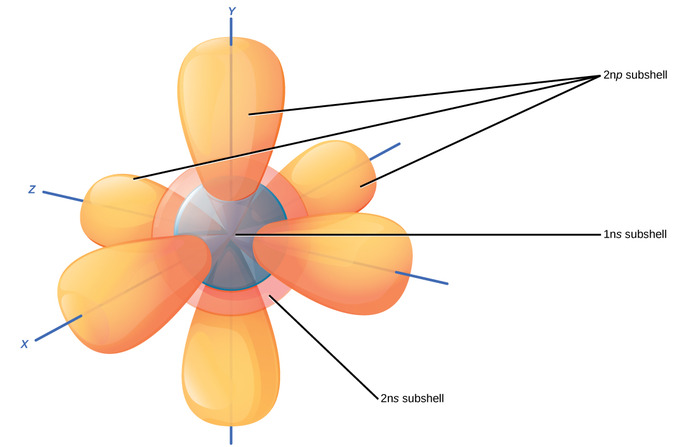
Third Electron Shell
Larger elements have additional orbitals, making up the third negatron cuticle. Subshells d and f have more complex shapes and contain five and septet orbitals, respectively. Principal blast 3n has s, p, and d subshells and can give 18 electrons. Principal cuticle 4n has s, p, d, and f orbitals and can curb 32 electrons. Flaring away from the nucleus, the number of electrons and orbitals found in the energy levels increases. Progressing from one atom to the next in the periodic postpone, the electron social system can be worked out by trying on an extra electron into the next available orbital. While the concepts of electron shells and orbitals are closely age-related, orbitals provide a more dead on target depiction of the electron configuration of an atom because the orbital pose specifies the different shapes and special orientations of all the places that electrons may occupy.
How Many Electrons Can a Single Orbital Hold?
Source: https://courses.lumenlearning.com/introchem/chapter/electron-orbitals/
0 Response to "How Many Electrons Can a Single Orbital Hold?"
Post a Comment